The NYT's Burns takes a moment to contrast the reality of yesterday's fighting with the somewhat more sanguine spin offered by U.S. spokesmen. Burns says a "senior American officer rushed into a news briefing inside the American headquarters compound in central Baghdad wearing a helmet," and said, the fighting represented "a fairly significant event," adding, "At this point, it's pretty settled down."
Category: Uncategorized
Marriage
This is best story about the marriage debate I've seen. Even though it isn't ostensibly about the gay marriage debate. It's about my friend Cora's parents an their decision not to marry. Unspoken is the context that when they met, a marriage between them -- a black man and a white woman -- had only recently become legal in many states. -------------------------------------------------------------------------------- April 4, 2004 LIVES Not the Marrying Kind By CORA DANIELS found out in sixth grade. I was supposed to go to a friend's house after school, but during lunch period, she remembered it was her parents' wedding anniversary. I'd have to come over another afternoon. I understood. It was the divorce decade of 80's Manhattan; we were two of the few kids in our class who even lived with both of our parents. So an anniversary wasn't something that should pass without notice. And it got me thinking: why was it that I never made my parents an anniversary card? My family was close. Most days, we ate dinner together at 4:30 in the afternoon because my dad's shift ended at 4. On weekends, the four of us -- my parents, my younger brother and I -- would ride our bikes through our neighborhood like some street gang pedaling in unison to jam sessions in Washington Square Park. But we never celebrated my parents' anniversary. After school, I asked my mom why. A little pink in the cheeks, she shot back that they had never been married. To say that my parents were unconventional is an understatement. They met in the late 60's, when they were New York City cabdrivers and worked out of the same garage. My dad was black, from a rough part of Chicago and 14 years older. She was white, Jewish, from a tiny town in Virginia and living on her own for the first time. The story goes that one day in the garage, my dad asked my mom out for coffee. My mom replied that she didn't drink coffee. From there, the simple mating ritual deteriorated into an argument over whether the offer was limited to just coffee or could also include tea or even conversation. Within 14 seconds, my mother says, she was in love, and within 16 seconds, they were fighting. It was a pattern that never stopped. They did not marry because she didn't want to. It was completely unnecessary and too conventional. If you loved someone as deeply as she loved my father, there was no reason to limit that love with legal binds. It wasn't that my mom didn't want a wedding. If that had been the case, they could have gone to City Hall, as most of their friends had. She didn't want a marriage. Without the piece of paper, she felt, their connection was pure, limitless and unscripted. Through the years, I've reacted differently to my parents' decision. During college, when I left the city and mingled in much more traditional circles, I was proud of their nonconformity and would tell acquaintances that they had never been hitched. More recently, as a black woman surrounded by a generation of unmarried parents dragging a community further into poverty and dysfunction, I don't bring it up as much. Almost five years ago, I married. You can see my parents' shock on the wedding video. I purposely kept my mom in the dark about the details of my wedding day, because the experience would be a first for both of us, and I wanted her to be surprised. I think she appreciated the gift. When I took my fiance -- instead of her -- shopping for bridal gowns with me, the uptight salespeople freaked, but not my mother. In the end, it took death to part my parents. When my dad went suddenly three years ago, they had been together 30 years. It was a lifetime more than many of us get with people we vow to love forever. Without a marriage certificate though, my mother wasn't my father's next of kin under the law. As my father's oldest child, it was my say that counted. Every time I signed another document, it felt as if I were further erasing my mom's role in my dad's life. Or at least helping society to. My dad, an Army vet, had a formal military burial. After taps was played, soldiers folded the flag draped on my father's coffin and presented it to the family. Actually, they handed the flag to me. I didn't want to take it. It should have been presented to my mother, whose lap was empty. But she was not his wife, so the military refused. The idealistic bubble my mom had created for their love collapsed when it rubbed against the real world. No one cared about our weekend bike rides. My mom, my brother and I rode home from the funeral in silence. In a room full of friends and family who had gathered at the house, my mom whispered to me that her only regret was that she never married my dad. If she had it to do over again, she would have. We hadn't spoken about the fact that they weren't married since that day after school when I was 11. My mother's remorse is much larger than flags or funerals. I understand that now. She had believed the world could see the love and commitment that she and my dad shared. But what she didn't grasp sooner is that when you are lucky enough to find a love as strong as she found, you show it off to the world proudly. Because in the end, regretfully, the world couldn't see what they shared. Now, when I look at my wedding band, I can't help thinking of my parents and what they gave up because they thought their hearts were all that mattered. Cora Daniels is a writer at Fortune magazine and the author of ''Black Power Inc.: The New Voice of Success,'' to be published by John Wiley & Sons this month.
The Evils of the Player Piano
The EFF directs us to an article by John Phillip Sousa, warning against the evils of recorded music. The argument is eerily familiar:
"I foresee a marked deterioration in American music and musical taste, an interruption in the musical development of the country, and a host of other injuries to music in its artistic manifestations, by virtue -- or rather by vice -- of the multiplication of the various music-reproducing machines." "[F]or the life of me I am puzzled to know why the powerful corporations controlling these playing and talking machines are so totally blind to the moral and ethical questions involved. Could anything be more blamable, as a matter of principle, than to take an artist's composition, reproduce it a thousandfold on their machines, and deny him all participation in the large financial returns...?"
Iraq on the Record
Representative Henry Waxman's staff has put together Iraq On The Record, a collection of the Bush Administration's false or misleading statements about Iraq.
Statement by National Security Advisor Condoleezza Rice"[H]e had . . . an active procurement network to procure items, many of which, by the way, were on the prohibited list of the nuclear suppliers group. There's a reason that they were on the prohibited list of the nuclear supplies group: Magnets, balancing machines, yes, aluminum tubes, about which the consensus view was that they were suitable for use in centrifuges to spin material for nuclear weapons."
Source: NewsHour with Jim Lehrer, PBS (7/30/2003).Explanation: This statement was misleading because it suggested that Iraq sought aluminum tubes for use in its nuclear weapons program, failing to mention that the government
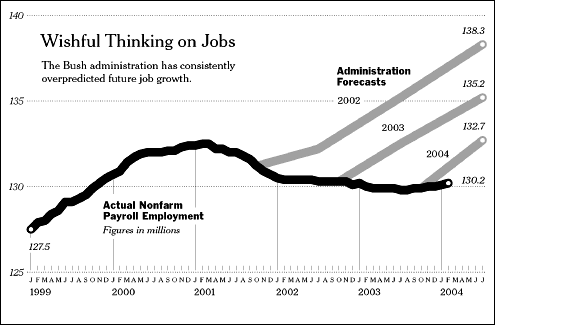
Administration Job Forcecasts

WMD Argument Comes to a Head
On the same day that the anti-war Carnegie Endowment for International Peace released a report stating, under no uncertain terms, that the Bush Adminsitration "systematically exaggerated" Iraq's WMD capability, the U.S. Joint Captured Materiel Exploitation Group leave Iraq. So after nine months, no WMD are found and the Bush Administration withdraws 400 of the 1400 staff on their weapons inspection staff. Hoping tenacity and reptition can overcome reality, the U.S. Secretary of State Colin Powell provides the most tepid defense of the Administration's policy to date: "I am confident of what I presented last year, the intelligence community is confident of the material they gave me," Mr Powell told reporters.
All Your Credit Card Statement Are Belong To Us
The Saturday before Saddam Hussein was captured, President Bush signed into law the Intelligence Authorization Act of Fiscal Year 2004. Tucked away in this legislation is language allowing the FBI to collect any citizen's financial information without judicial review or meaningful Congressional oversight. Pour yourself a cup of coffee and read Section 374 of the law for details. This means that an FBI agent can draft a "national security letter" (NSL) and, as if by magic, get "financial information," which is newly defined to include your transactions with stock brokers, travel agents, jewelry stores, the U.S. Post Office, casinos, and real estate agents, and car dealerships. The support for this provision was predicated on an urgent need for the FBI to get this information. This is difficult to understand, since the FBI already has the power to get this information under Section 215 of the Patriot Act. Strangely, the FBI claims that it has never used the this power. So what's going on here? Why give them this power when they're not using the power they already have? The answer is that the FBI doesn't want to use Section 215 of the Patriot Act. The FBI is finding these NSLs much more useful. NSLs don't require the approval of the FISA court and the minimal oversight that provides. NSLs are practically immune from Congressional oversight. They're also completely opaque to the public: for example, EPIC filed an FOIA request for the list of NSLs that have been issued, and here's what they got: a six page list, entirely redacted with black marker. Many news services and web sites have characterized this surreptitious change as an expansion of the FBI's power -- which is a terrible mistake. The FBI has been able to get these records all along. What they wanted, instead, is to exercise this power without any oversight, criticism, scrutiny or transparency. Essentially: Congress willingly surrendered its resposibility to hold the FBI accountable.
Why You Care About Thune
Jobless Count Skips Millions
A quick reminder that even your favorite economic indicator is more likely to be a statistically convenient fiction than an accurate index: From LAT, 29 December 2003:
The nation's official jobless rate is 5.9%, a relatively benign level by historical standards. But economists say that figure paints only a partial
Treasury’s Snow Starts the Crazy Talk
Treasury Secretary Paul O'NeillJohn W. Snow predicts that there will be two million new jobs before the election. "I would stake my reputation on employment growth happening before Christmas," Snow said. That forecast flies in the face of every meaningful analysis in both the public and private sectors. You might even call his prediction optimistic... or maybe "irrational".
But it gets worse. Later in the same interview, he predicts that interest rates would rise, despite the Fed's insistence that interest rates would stay low for "a considerable period of time." Yes, it's always a good idea for the Treasury to second-guess the Fed. Snow apparently got a strongly-worded memo about that: he walked it back the next day.
What is it with the unscripted Treasury Secretaries?
 a technology job is no excuse