Weight Watchers wasn't always the bastion of cool it is now. It used to be nasty.
Category: Unfiled
Operation: Iraqi Mackin’
The new regime is love, baby.
Precious Iraqi Moments
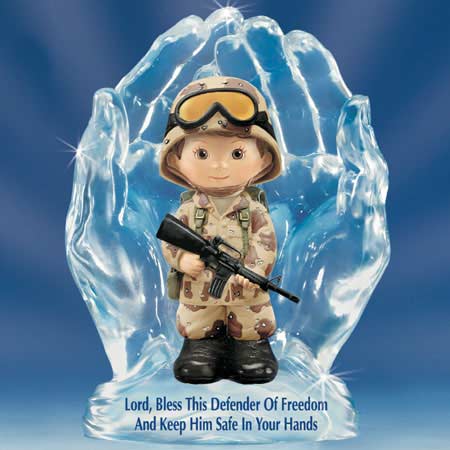
A number of us have worked in the giftware industry, and have seen more than our share of crap. This is stunning.

SARS Spreads


OnePeople.org Official SARS LogoWe were beginning to feel like delusional paranoids after reporting that the SARS outbreak was coming under control and patients were being discharged. Buried amongst the war items today, Reuters is reporting that the U.S. State Department is encouraging citizens in Vietnam to leave, even offering to pay for the plane home for diplomat's families. Five schools are now closed, and cases have been confirmed in Germany and Britain. Scientists have identified the virus, which is probably in the paramyxovirus family, of measles and mumps fame. In a darkly humorous twist, the Hong Kong Hospital Authority chief William Ho has been hospitalized with symptoms of pneumonia.
Get Your War On
It's clip art, it's sarcastic, it's a nuanced commentary on the war. Get Your War On!
SARS: Good News/Bad News
As a followup to our previous coverage of the SARS outbreak, three schools in Hong Kong have been closed, and they've figured out that a professor visiting Hong Kong from the Chinese mainland was the source of the hotel outbreak, which sickened the first batch of six in Hong Kong. Worldwide, there are 350 cases and six deaths. The good news: vigorous treatment seems to help. Many of the hospitalized patients in Hong Kong are being sent home. While no cause has been found, the WHO has sent a team to the Guangdong province in China, which borders Hong Kong, to determine a link between SARS and the atypical pneumonia outbreak there last year.
MoJo on Blood for Oil

"I have sinned in my heart."MotherJones has a great piece on the "Blood for Oil" story, with a short history of American policy in the Gulf. It starts sounding an awful lot like alarmist petro-conspiracy nonsense, but there's enough useful information there to make it worth reading. It undermines the antiwar "Blood for Oil" argument, and replaces it with a more far-fetched and creepy argument against American aspirations of global domination.
The article describes U.S. policy in the Persian Gulf after the Oil Crisis of the 1970s. Suddenly concerned with its access to oil, the United States diversified its oil vendors and began a deliberate campaign to assert influence over the oil-producing states in the Gulf. This was either a result of, or was closely harmonized with, some hawkish global dominance thinking and the influence of Kissinger.
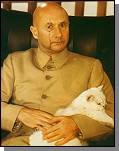
The strategy proposed by the conservative think-tanks (and Kissinger, apparently) was not about getting oil but rather controlling access to oil. If the U.S. can reduce its own dependence on Gulf oil, and can prevent others from getting that same oil, they will "control the spigot" and extend its reach to every oil-consuming country in the world. One struggles to imagine President Carter in a black nehru jacket, petting a white persian kitten.
In order to assert this hegemony, the US is supposed to overthrow governments in the region and install friendly regimes... and everyone knows how good a track record we have doing that. In actuality, of course, the US has supported the existing regimes and the alternate oil vendors in the western hemisphere can't really meet the US demand. This gap between the plan and the actual history is fairly wide, and goes mostly unaddressed by the article.
Near the end of the piece, MoJo cites the opinion of the oil industry commentariat, which indicates that the oil industry is nervous about war in the region and would much rather have the corrupt stability of the existing leadership, instead of the uncertainty of a regional conflict. This is, of course, where the traditional "Blood for Oil" argument breaks down.
The question raised by the article is not whether hawkish portions of the Bush Administration want to control the Persian Gulf -- of course they do. The article cites many papers and meetings on the subject. They want America-friendly democracies with American military bases pumping oil to American consumers. Deputy Secretary of Defense Paul Wolfowitz has been a vocal proponent of this policy, adding a dash of pro-democracy and human rights reasoning. Instead, the question is whether or not this is a plausible policy that won't make things worse for both the Gulf and America in the long term. The answers, of course, will make themselves very clear during the purge and reconstruction in Iraq.
SARS Spreads
It's being called Severe Acute Respiratory Syndrome, and it's spreading. The Beeb has provided a map of confirmed infections. They've also provided a handy FAQ. It's being transmitted by air travel, of course. The experts interviewed are not very concerned. Pay attention to how many new cases have been found since we last mentioned this, and keep in mind that there's a two-day incubation period before symptoms arrive. According to this CDC press call, cases may have appeared in Georgia and New York. At the time of this writing, Reuters is reporting Britain's first case. OnePeople is also delighted to see that the BBC has also picked up on the Spanish Flu meme, advanced in these pages, and also by New Zealand Prime Minister Helen Clark. The Beeb jauntily claims that it's not as bad as the Spanish Flu epidemic of 1918, since it isn't a flu, and hasn't yet killed 40 million. A cold comfort. For the real alarmists: everyone has issued travel warnings, and they're sanitizing airplanes. Says one expert: "There's no much you can do to avoid this, unless you go and live as a hermit."
Domino Democracy Doomed


"Trust me, Jenny. Democracies love you."
If Saddam Hussein is removed, the U.S. has pledged to encourage an Iraqi democracy that will be a model for democratic government in the Middle East. The hope is that the Arab Street is secretly hoping for democracy, and that new democracies in the Middle East would be naturally more sympathetic to the United States.
The State Department popped that balloon with a report to top-level government officials which casts serious doubt on the ability of an Iraqi democracy to encourage democracy elsewhere. "Iraq, the Middle East and Change: No Dominoes" asserts that democracies are unlikely to develop before more pressing social and economic issues are resolved. Even if new democracies develop, the report warns that anti-American sentiment is likely to create more Islamic governments hostile to the United States.
This flies in the face of the "Democracy Domino" camp, led by Deputy Defense Secretary Paul D. Wolfowitz. The idea that an Iraqi democracy will encourage the development of democracy elsewhere in the Middle East is central to the Bush Administration's case for regime change. Thanks to the L.A. Times, we know that even Bush's own State Department doesn't believe him.
Georgie loves Tony
When you give the Swedes b-roll of George Bush and Tony Blair, Lionel Richie standards, and digital editing equipment, madness ensues.
 a technology job is no excuse