Everyone remembers the McCain-Feingold campaign finance reform, and a few of you might remember that it's been put on hold while the courts mull over the inevitable Constitutional challenges. That's where the story ended for most people; everything else is "inside baseball" which rightfully bores people to tears. Sometimes, though, inside baseball is interesting. In the last week, reports began appearing on NPR and the Washington Post that the three judge panel considering the McConnell v. FEC is deadlocked, not on the matter per se, but because they just can't work together. Judge Karen L. Henderson announced from the bench that the court would have a decision by mid-late January. This surprised and angered the other two judges, who are accustomed to taking their time after oral arguments. Judge Henderson is rumored to already be writing an opinion, while the other two are reviewing the 50,000 pages of evidence and 1,600 pages of briefs filed with them. These two judges and Henderson have barely talked at all in the last few months, a time when all three are supposed to be crafting a formal decision, which typically weighs in at 1,000 pages. Take a moment to consider how bad things must be in those chambers if the Washington Post is talking about it -- someone had to breach ethics rules to leak this information. Once you've fully considered the magnitude of this mess, imagine writing a 1,000 page book with two other people, and not talking to them. The court's decision could be delayed for months. But who cares? Everyone cares, which is why this decision was supposed to be fast-tracked in the first place. If the panel does not deliver a timely decision, the Supreme Court will not be able to hand down a decision on the matter before the 2004 elections. Everyone agrees that this would be a bad thing, hopelessly complicating the election for all involved. The supporters of McCain-Feingold are especially interested, though, because they are afraid that the usually campaign-finance-reform-friendly Chief Justice Rehnquist will retire and be replaced with a campaign-finance-reform-hostile Bush appointee. So the stakes are very high now, and everyone would like to see this law off the desk of the three federal judges. Some are suggesting that the McCain-Feingold supporters petition the Supreme Court for a mandamus, which would compel the panel to adhere to a timetable. Others are less alarmist, and point out that the last major campaign finance reform case, Buckley v. Valeo, took eight months to reach to Supreme Court in 1976. The Supremes heard arguments in November, and had a decision by January. Buckley wasn't as complex as this case, though -- there are two dozen substantial provisions to consider.
Triple Threat
North Korea's leader, Kim Jong-il, has made a bold move to secure control over all weapons his enemies could use against him. No, this is not what you think.
Oral Arguments
If our faithful readers missed Slate's coverage of the Supreme Court's oral arguments, you are all the poorer for it. The Court heard some great cases, and Senior Editor Dahlia Lithwick did a fine job not just with the content of the arguments, but with the snappy banter at the bench. Take the Virginia v. Black cross-burning case:
Perhaps it's because Chief Justice William Rehnquist is still home recuperating from knee surgery and Justice John Paul Stevens presides with a lighter touch, but everyone seems to be acting out like they would with a substitute teacher....and she's not exaggerating. The Supremes can be really funny. The Lawrence v. Texas sodomy case also has some great highlights:
In response to a question from Justice Anthony Kennedy as to whether Bowers is still good law, Rosenthal replies that mores have changed and that "physical homosexual intimacy is now more acceptable." Since he suddenly seems to be arguing the wrong side of the case, an astonished Scalia steps in to say, "You think there is public approval of homosexuality?" Rosenthal catches his pass, then runs the wrong way down the field: "There is approval of homosexuality. But not of homosexual activity." Scalia wonders how there can be such widespread "approval" if Congress still refuses to add homosexuals to classes of citizens protected by the civil rights laws. "You're saying there's no disapproval of homosexual acts. But you can't ... say that," he sputters.There is nowhere near enough good coverage of the SCOTUS, and it's a shame. These are smart people, working out hugely important issues -- and despite, or perhaps because of the black robes and specialized vocabulary, they can be funny. It takes good writing to bring this out, so full marks to Lithwick and Slate.
Arab News and War Coverage
To sate our insatiable appetite for war coverage, we've been combing the Internet for any English-language Middle Eastern media outlets we can find. We stumbled upon Arab News, which is published in English in Saudi Arabia, and has a number of reporters embedded with the US military. Many of the Arab News articles seemed a little, you know, tainted, so we poked around. Before long, we found them accusing Israel of launching the 11 Sep 2001 attacks in December 2002. That made them obnoxious, but we'll write that off to the general post-attack hysteria. A little more poking around, and they surpass "obnoxious", reaching "intellectually bankrupt". Here's a well-considered piece of reporting accusing the whole of the US media of being in the pocket of Israel. I like to think of the author, Hassan Tahsin, as their Thomas Freidman... except, you know, crazy. That gem also contains the OnePeople Quote of the Day:
"Moreover, as Zionism is surviving on lies, it exploits every opportunity to target Islam and this is evident following the September attacks on the US. Therefore, the US media that are controlled or dominated by Zionists continue attacking Islam, Muslims and Arabs taking advantage of the fact that the prime suspects in the attacks are Arab or Muslim."Incidentally, the parent company of Arab News is H.H. Saudi Research and Marketing Ltd (SRM), chaired by Prince Faisal Bin Salman Bin Abdul Aziz Al Saud. You can watch him duck important questions about the Saudi regime and Wahhabism in this interview on PBS' NewsHour.
Drugs=Terrorism Spots Killed
Remember those intellectually soft drugs-users-pay-terrorists ad campaign? The Office of National Drug Control Policy killed the spots because they were off-message, untrue, and ineffectual. The Partnership for Drug-Free America didn't like them for being "off-strategy" -- though that maybe more about Ogilvy and Mather doing the creative, which is usually the PDFA's job. Most progressive/decriminalization groups think the campaign was misleading, as terrorists come from dysfunctional foreign policy, and not potsmokers. But they don't like the idea of anti-drug campaigns anyway. The cited reason for killing the spots, though, was that they totally failed, just like all the other ONDCP campaigns. Recall that in March 2002, O & M had to pay the GAO $1.8 million in fines for billing 3,100 hours of questionable work to the ONDCP in 1999 -- and they still got the contract for the campaign, which started in February 2002. You can read the full GAO report from August 2001. PS - All of this is paid for by the government, i.e. you.
Let the Christianization Begin
Sunday: PRAY that the President and his advisors will seek God and His wisdom daily and not rely on their own understanding.That's "A Christian's Duty", from the good people at In Touch Ministries. The Australian ABC is reporting that the pamphlet was distributed to US troops in Iraq. It's unlikely that the government had anything to do with it, but it's also unlikely that a quarter million copies of Harper's would reach the troops.
Monday: PRAY that the President and his advisors will be strong and courageous to do what is right, regardless of critics.
Precious Iraqi Moments
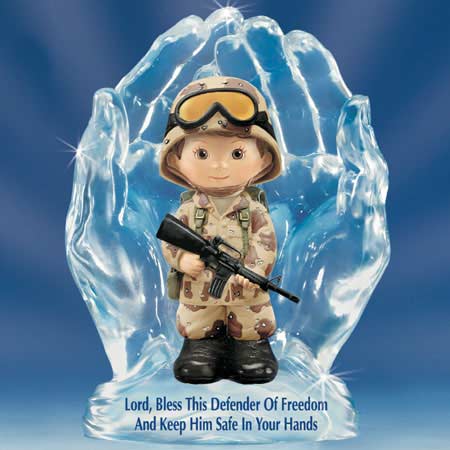
A number of us have worked in the giftware industry, and have seen more than our share of crap. This is stunning.

House Shelves Honors for Djindjic
Serbian Prime Minister Zoran Djindjic was recently assassinated, but won't receive condolences from the US House of Representatives despite leading his country through a series of important reforms and its reconstruction after Milosevic. Why? Last Sunday, while you were watching Six Feet Under, Ed Bradley was on 60 Minutes with documents that indicate Yugoimport, the government's arms export company, was providing equipment and services to Iraq. One memo to the Iraqi Ministry of Defense gives instructions on avoiding UN weapons inspectors. It's unclear exactly how much support was being provided, but it's probably in the neighborhood of US$1.5 billion and US$3 billion. This includes jet engines, artillery shells, and anti-aircraft technology. There's some question as to exactly how much control Djindjic had over Yugoimport, since it is still largely in the hands of the generals of the Yugoslav National Army (JNA) who ran it before the war. Most agree that the Prime Minister was at least aware of the deals. This scandal has also taken down the Serb member of the ruling triumvirate in Bosnia. Do you get the feeling that the United States was the only country that honored the sanctions?
Parameters
If you're under the impression that the military is a monolithic, unthinking, unquestioning bureaucracy, you'll be surprised by Parameters, the journal of the US Army War College. Think of it like Foreign Affairs for senior Army officers. Many of the articles are very relevant right now, including The CNN Effect: Strategic Enabler or Operational Risk? and The Moral Limits of Strategic Attack, which discusses the moral and practical issues surrounding "noncombatant immunity" and the Pentagon's "effects-based" bombing strategies. The Bush Doctrine and War with Iraq is a wonderfully candid analysis of the new National Security Strategy. This is a wonderful resource, and unbelieveably, it's free.
War for Oil, But Not What You Think
It turns out that this may be a war for oil after all, but not in the way that you think. The United States has made it pretty clear that it's not interested in Iraqi oil, but the opponents of the war seem awfully interested: scroll down to Section 2(b) of this Cooperative Research report on Iraqi Oil and Gas Reserves. It mentions a Department of Energy report documenting Iraqi oil contracts with "Italy (Eni), Spain (Repsol YPF), Russia (Tatneft), France (TotalFinaElf), China, India, Turkey, and others." We've hinted at this before, but now we'll come out and say it: could it be that some opposition to this war isn't high-minded internationalism, but a craven attempt to ensure these contracts pay out?

